Exploration of El Castillo Pyramid Begins for DU-Led Project

This article appears in the Spring 2026 issue of the Dominican Magazine.
Return to the Table of Contents.
Under an ancient Mayan pyramid, a cosmic-ray-catching device with origins at Dominican University is making history.
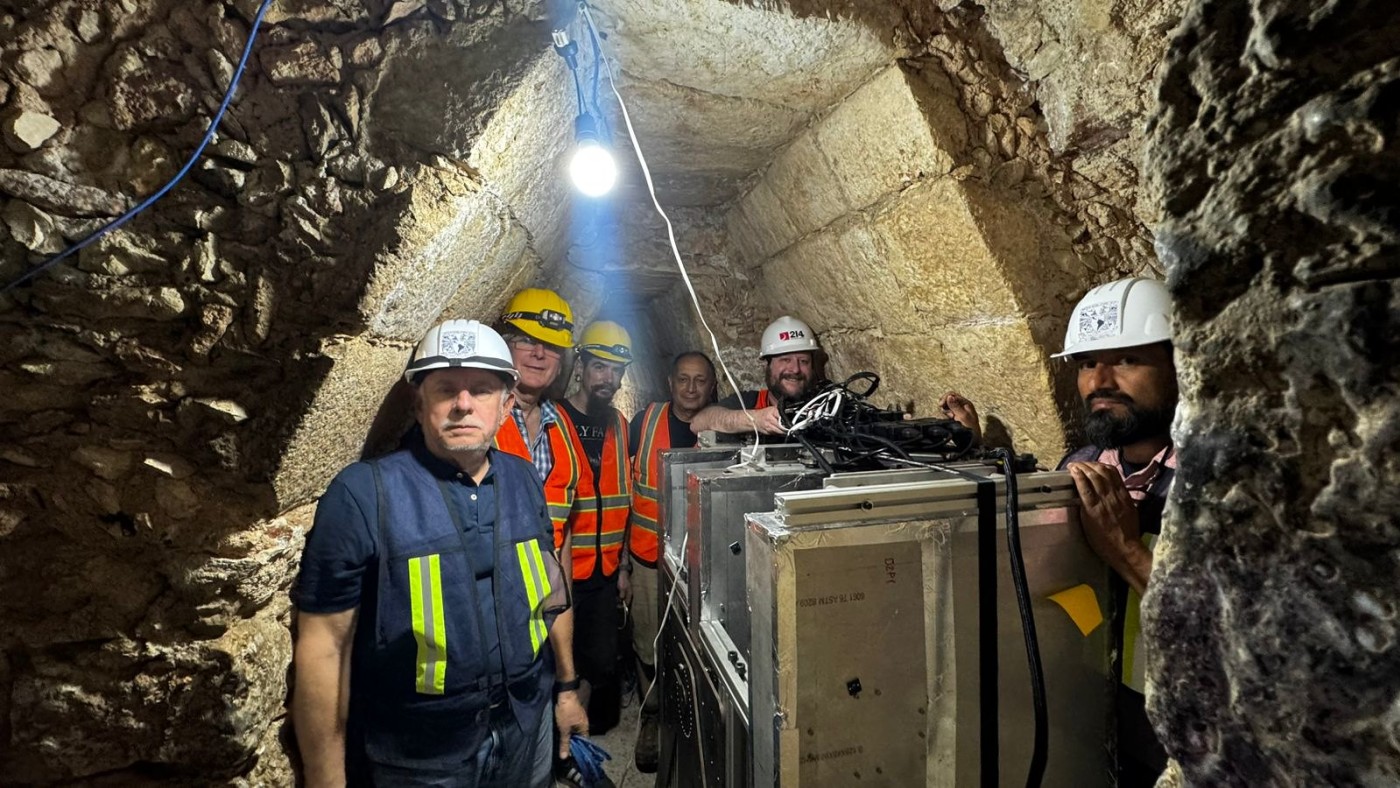
Known as a muon detector, the device was installed Jan. 28 inside a tunnel in El Castillo (also known as the Temple of Kukulkan), a 1,000-year-old pyramid in Mexico’s Yucatán Peninsula.
Through the detection of muons—particles from space that are similar to electrons—the device acts like an X-ray machine, creating images that can help scientists and archeologists examine beyond the pyramid’s interior stone walls and identify any voids. This could lead to the discovery of previously unexplored spaces and structures inside the historical site.
This is the first time a muon detector is being used at the pyramid for research and data collection. It’s the culmination of years of planning, prep work and testing undertaken by DU students, Physics Professor Dr. Joe Sagerer, and five partner institutions.
“I would love to find something the archeologists don’t know about,” said Sagerer, who joined the January installation. “But we just don’t know. And that’s the exciting part. You don’t know until you look.”
It will be a few months before any images will be created by the detector, he noted.
The Non-Invasive Archaeometry Using Muons (NAUM) project is a collaboration between Dominican University, Chicago State University, Universidad Nacional Autónoma de México, Instituto Nacional de Antropología e Historia in Mexico, the University of Virginia and Fermilab.
A National Science Foundation Grant secured by Dominican and Chicago State University helped fund the project.
“When students have a chance to do research, it introduces them to how things work in the real world,” Sagerer said.