The Bedrock of a Flourishing Community

This article appears in the Spring 2026 issue of the Dominican Magazine.
Return to the Table of Contents.
Achieving 125 years of excellence in education happens only with a firm foundation, an enduring mission and the leaders and educators who carry that mission forward.
Dominican University can celebrate this milestone anniversary today thanks to the generations of Sinsinawa Dominican Sisters who prioritized access to education—first for women, and later to all—and empowered students to serve meaningfully in an ever- changing world. These are the Sisters who, using their own unique gifts, stepped up to lead, to teach and to walk beside the students in their care.
Dominican’s founding would not be possible without the four “Cornerstone Sisters,” as the first Sisters of the Sinsinawa Order became known: Sr. Clara Conway, OP; Sr. Josephine Cahill, OP; Sr. Ignatia Fitzpatrick, OP; and Sr. Rachel Conway, OP. These are the Sisters who, guided by Fr. Samuel Mazzuchelli, OP, established the community’s longstanding vision and values.
“This is the DNA of the Sinsinawa Dominicans,” said Sr. Priscilla Wood, OP, the current director of arts and cultural heritage for the congregation.
That DNA was passed down to other leaders who would cultivate the Sinsinawa Dominican roots in Catholic education. Expansion came under the leadership of Mother Emily Power, OP, who oversaw the 1901 transition from St. Clara Academy—already known for its rigorous curriculum in arts and science—to St. Clara College, which met a need for women seeking higher education and opportunities.
The college’s exceptional reputation, established by Mother Emily, would be upheld over the next century. And it would serve to grow the college, leading Mother Samuel Coughlin, OP, to push forward in establishing the newly named Rosary College in River Forest in 1922.
Mother Emily and Mother Samuel were extensions of the vision of Fr. Samuel and his Catholic social teaching principles, which made them successful leaders, Wood believes.
“These two women were in leadership for 82 years combined; they became the bedrock of a flourishing community,” Wood said.
The Sisters who accompanied and later followed these “bedrock” leaders are many. In marking Dominican University’s 125th anniversary, Dominican Magazine highlights three unique Sisters whose impact on students—and society as a whole—profoundly connects to the present day. These Sisters led the way in social justice work to transform harmful beliefs about race, build a robust library program based on the pursuit of truth and become a legacy for the liberal arts for years to come.
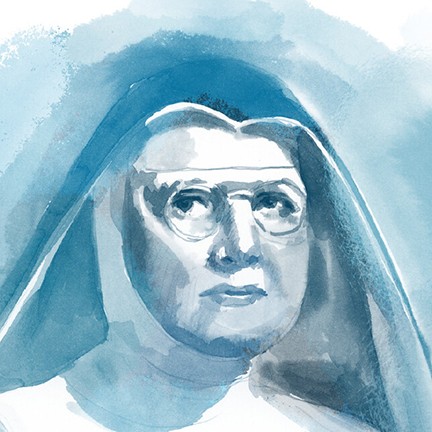
Sr. Mary Ellen O’Hanlon: Committing to Social and Racial Justice
A sabbatical year in mid-1930s Europe led to a life-changing, self-described “awakening” for Sr. Mary Ellen O’Hanlon, OP.
“I was ready to say that I liked nearly everything in Europe excepting one,” Sr. Mary Ellen wrote in her autobiography, Three Careers. “I had the temerity to say that I did not like the caste system in European countries—their distinctions between the peasantry and the upper classes.”
On the heels of this admission, came a striking realization: Wasn’t this the same way Black Americans were treated in the United States?
This moment would shift the focus of Sr. Mary Ellen’s life and become a touchstone for future social and racial justice work at Dominican University.
A professor of botany at Rosary College, Sr. Mary Ellen would combine science and Catholic teaching to confront misinformation about race and encourage a message of unity over prejudice born of perceived differences.
In 1946, Sr. Mary Ellen published Racial Myths, a booklet dispelling common-held beliefs of biological differences and inferiority among Black populations, and calling race itself a myth, noting that all human beings “are descendants from a common ancestry.” She noted the “superficial traits and characteristics which seem to differentiate the ‘races’ of man have little significance scientifically so far as fundamental differences are concerned.”
Such a declaration would come years before advancements in DNA analysis would further prove her correct.
The Heresy of Race, Sr. Mary Ellen’s 1950 follow-up to Racial Myths, called racial prejudice a “poison” and examined humanity through a faith-based lens. The soul, she wrote, “has neither race nor color.”
Her writings led to invitations to address and educate students and groups around the country, including the segregated south. She was named a consultant to the intercultural committee of the Archdiocese of Milwaukee and spoke out against antisemitism as well.
In 2013, Sr. Diane Kennedy, OP, inaugural vice president for Mission and Ministry at Dominican University, credited Sr. Mary Ellen’s advocacy and writing for helping to “lay the moral and intellectual foundation for the civil rights movement.”
Dr. Precious Porras, Dominican University’s vice president for Justice, Equity and Inclusion, calls Sr. Mary Ellen’s work “groundbreaking” for a time when eugenics, with its racist ideology of white superiority, was a global movement.
“Sr. Mary Ellen’s work was crucial because it used real science to prove eugenics was using false science to tell us Black folks were inferior,” Porras said. “She was saying, ‘Actually, no. The science doesn’t support that at all.’”
Today, social and racial justice work is imbedded in the fabric of Dominican University and is a continuation of Sr. Mary Ellen’s far-reaching conversation of unity and belonging. This modern work focuses on harm reduction and removing barriers to education and social mobility for historically marginalized populations, which represent a majority of Dominican’s current student body, Porras explained.
Sr. Mary Ellen’s willingness to openly talk about race is also notable and inspirational today because there remains push-back against such discussions in the United States, Porras said.
“Sr. Mary Ellen was very brave to stand up and use both science and faith to address racism,” she added. “In 2026, I would hope we understand the immorality of racism, too.”
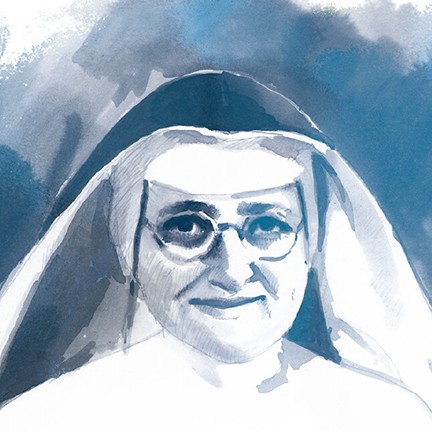
Sr. Mary Reparata Murray: Shaping a Forward-Looking Library School
There’s a tale about Sr. Mary Reparata Murray, OP, that has become part of Dominican University lore.
Praying that one day soon Rosary College would have the financial means to build the grand library that had been envisioned since the college settled in River Forest, Sr. Mary Reparata, Rosary’s first librarian, set about burying a medallion of St. Joseph in an open campus field.
Decades later, as the story goes, construction crews found it.
“They were breaking ground for the current Rebecca Crown Library when they recovered the medallion—exactly in the spot where the library was to be built,” said Steven Szegedi, Dominican University’s archivist and special collections librarian.
And though Sr. Reparata would not see her prayer realized during her lifetime, her role in establishing Rosary College’s first library and first department of library science lives on today in Dominican University’s robust graduate program, which has educated countless librarians, library directors and researchers across not only the Chicago area, but the country as well.
The Rosary College Library was established in 1922 as a continuation of the St. Clara College Library. It was housed in what is now known as the Noonan Reading Room until the completion of Rebecca Crown Library in 1972.
There had been courses offered in library science since the opening of Rosary College, but in 1930, Sr. Mary Reparata formally established the Department of Library Science and a 30-credit program to train undergraduate students to become high school and college librarians. The master’s degree program would be launched in 1949, bringing the college’s first male students to campus.
Writing of Sr. Mary Reparata following her death in 1954, William A. Fitzgerald, director of the library school at the Peabody College for Teachers in Nashville, Tennessee, called Rosary’s library school “a living memorial to Sr. Reparata in its reputation and in its alumnae.”
Dr. Don Hamerly, a professor of library and information studies at DU, credited Sr. Mary Reparata for leadership that was based in “serious intellect and moral clarity.”
“From the beginning, she taught librarianship as a vocation in the sense of a calling,” Hamerly added. “She understood that librarianship is fundamentally about stewardship, knowledge, communities and memory. When she proposed the first graduate program at Rosary College, she grounded professional education in librarianship as rigorous, values-based and forward-looking. Our faculty today follow that example closely.”
Sr. Mary Reparata’s transformative work was not limited to Rosary College. In July of 1938, a letter from Mother Samuel led to an extraordinary opportunity: An invitation to spend a year at the Vatican Library, assisting in cataloging of library collections.
“I am going to ask you to do something that is hard and, at the same time, delightful,” the letter began.
Upon completion of her duties, she was lauded by Anselmo M. Albareda, Vatican Library Prefect, in a letter that praised her “intelligent work” and service. This letter would be framed and displayed for many years at Rosary College.
Beyond the Vatican, Sr. Mary Reparata was a founder of the Catholic Library Association, a professional development and support organization that is still active today, and she served as its first female president from 1949 to 1951.
Today, Sr. Mary Reparata is most remembered for founding one of the earliest graduate library programs in the country and establishing the reputation that continues to empower its students.
“While the name of the school has changed, the mission has not,” Hamerly said. “We remain committed to the compassionate pursuit of truth.”
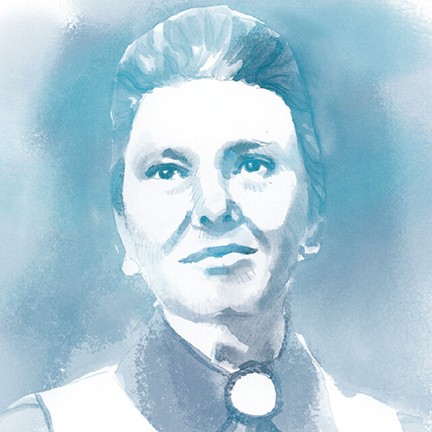
Sr. Gregory Duffy: Staging a Legacy in Liberal Arts Education
If Sr. Gregory Duffy, OP, kept a list of her favorite things, it’s a safe bet that the live theater world would be on it.
A professor of theater at Rosary College from 1942 to 1982, Sr. Gregory’s influence lives on in the script of The Sound of Music, the 1959 Broadway musical on which she consulted.
It’s the kind of contribution that exemplifies the unique backgrounds and keen subject knowledge that each Sinsinawa Sister has imparted on students over the last 12-plus decades.
Stacks of letters, preserved in Dominican University’s archives, tell a story of Sr. Gregory’s friendship with stage actress Mary Martin and her husband, producer Richard Halliday. Sr. Gregory met Martin, who debuted the role of Maria in The Sound of Music, through her New York theater connections.
The archives also include Sr. Gregory’s correspondence with the musical’s composer, Richard Rodgers, and lyricist, Oscar Hammerstein. Some of these letters are also held by the Library of Congress in its Hammerstein collection.
It was Martin who connected Gregory with the renowned theater-writing duo, as they were seeking guidance and perspective on Catholic religious life for some of their new musical’s scenes, said Szegedi.
Sr. Gregory’s early reviews of the scripts are noteworthy. In one correspondence she is critical of the way Captain Georg von Trapp’s character is written, calling him “cold” and suggesting audiences may react negatively to him.
“I want to see him when his guard is down because none of us can keep it up 24 hours a day,” Sr. Gregory wrote.
In a separate letter to Martin and Halliday, Sr. Gregory enthusiastically praised the portrayal of the nuns in the script, calling the characters “honest, human and almost completely believable.”
But to add to the authenticity, she offered suggestions, including, but not limited to, thoughts on how Maria, as a postulate, might speak to God as she prayed; the nuance of praying the Rosary or addressing the Reverend Mother; guidance on how characters interact and the tenderness that the Abbess might show Maria in a particular scene; and a light admonishment against scene direction calling for the Sisters to “giggle.” (“When laughter wells up, we are inclined to either smile or go all the way and laugh wholeheartedly,” she wrote).
Sr. Gregory even suggested a new scene that would depict the relationship of the Captain and Maria moving forward.
“I want to see something happening between these two that is unrelated to what they feel for the children,” Sr. Gregory noted.
Dominican University’s educational foundation is formed on the bedrock of the liberal arts, and Sr. Gregory’s critiques, even 70 years on, are still important examples for student writers, said Assistant Professor of English and author Dr. Maggie Andersen.
“Sr. Gregory’s contributions have much to teach us about the collaborative nature of writing,” noted Andersen, who teaches a course in playwriting. “We often think of writing as a solitary practice, and it is—until we need to solicit and integrate notes from editors, producers, actors and others.”
Sr. Gregory also exemplifies how skills students develop in their writing workshops can be used in life after college, she said.
“In workshop, we learn how to offer critiques just as Sr. Gregory did,” Andersen said. “Her notes demonstrate the emotional intelligence we’re working on when we read each other’s stories and offer feedback in the hopes of improving them. I wish she could see the students in the workshop now. They give incredibly insightful craft notes, and my hope is that that emotional intelligence will prepare them well to make the world a better place.”
The Sound of Music remains a beloved musical today, further connecting Sr. Gregory to the present. A Broadway production is currently touring the U.S. this year.