New Award Recognizes Dominican Student Writing
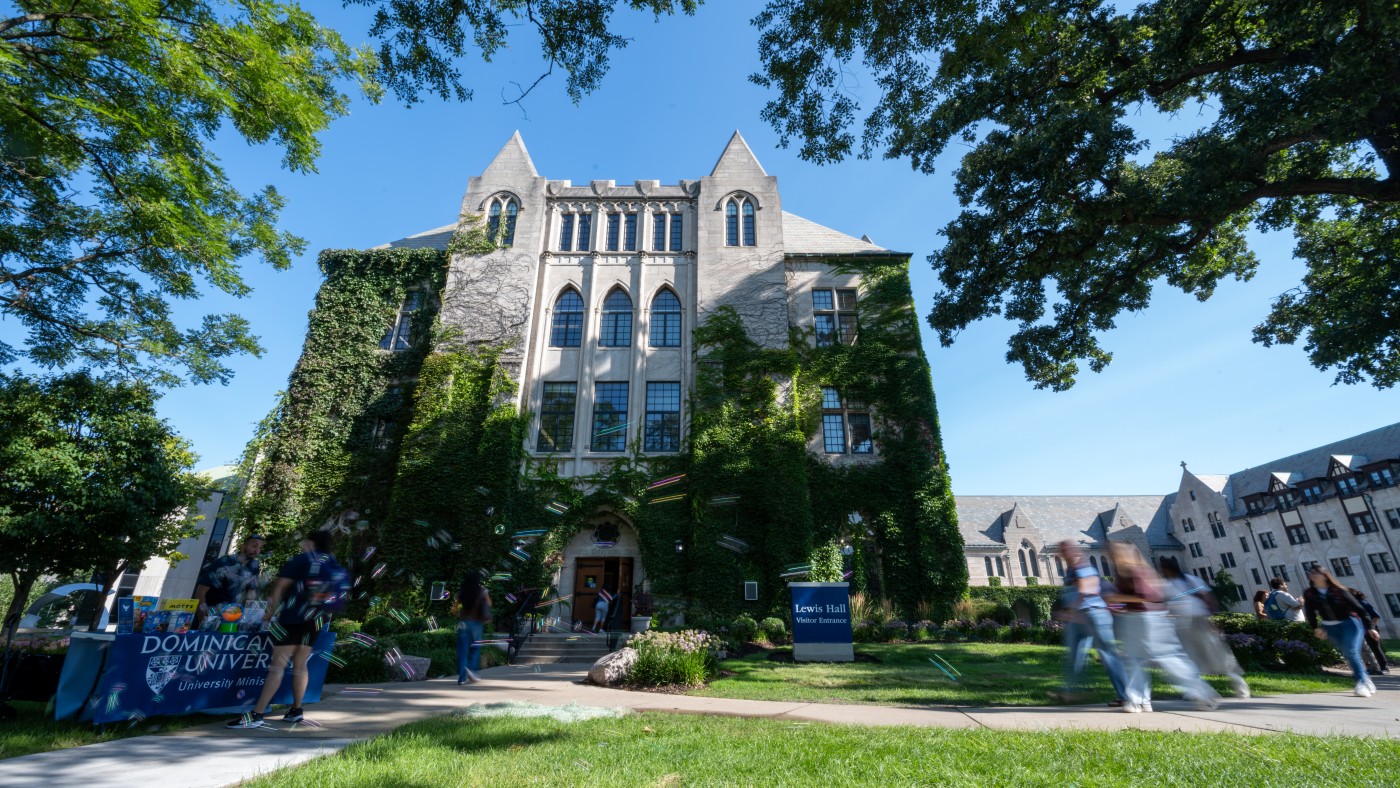
Two Dominican University students were recipients of the inaugural Sr. Marcella Hermesdorf Emerging Writer's Award this year.
Celebrating writing excellence and honoring Sr. Marci’s contributions as professor of English, the award was proposed by English professors Dr. Jodi Cressman and Dr. Maggie Andersen.
Johanna Rose Ignatius, a sophomore, was the winner in the Creative Genre category for her autobiographical account, Between Accents and Alphabets. In it, Johanna revisits the challenges she encountered with American English after arriving in the U.S. from Bangalore, India as a child. The piece is also a discovery of how words, languages and accents form one’s identity.
Mikayla Guadalupe Saldana, also a sophomore, was the winner in the Scholarly Genre category for her essay, Undocumented: The Weight of a Word, which explores how the word undocumented “evolved from a single descriptor to a powerful symbol of fear, resilience and identity” among immigrants.
The winning pieces can be read in their entirety below:
Between Accents and Alphabets
By Johanna Rose Ignatius
I still remember the February morning when my parents and I left Bangalore. The air was warm, and I could still hear the faint honking of auto rickshaws in the distance as we dragged our luggage into the taxi. India was all around me: the smell of Jasmine and Rose flowers from a street vendor, and the sound of my grandmother murmuring prayers in Malayalam before we left. I had left behind my notebooks filled with English essays and half-finished Hindi letters. But once we stepped onto the plane, those letters and books stayed by my desk in Bangalore.
When we landed in the U.S., I was surprised by the cold February air. My coat felt thin, and my accent suddenly seemed thick. The first thing I noticed was the snow. I pressed my nose against the window in wonder. I had only seen snow in pictures, but here it was right in front of me. It glittered across the ground like powdered sugar, soft, fluffy, and white, falling steadily from the bright sky. I scooped a handful into my hands and smiled as it melted into water on my skin. It felt like magic. Then I scooped up another handful and threw it into the air, watching it fall like glitter. It was as if I were inside a snow globe.
In Bangalore, the seasons were always the same: humid summers, heavy monsoon rains, and mild winters with cool nights. Here, I discovered there are four distinct seasons: spring with its blossoms, summer with its long days, autumn with its fiery leaves, and winter with its endless snow. That first snowfall made me hopeful, as though this strange new place holds wonders for me too.
Belonging, however, turned out to be harder than catching snowflakes. Though English had always been my first language, I carried it with the rhythm of India. My “t” was sharp, like the t in “Tap,” while theirs was softer, closer to a d. When I said “Water,” it was more like “Wa-TER” not “Wa-der.” Numbers were even trickier. In India, we said “Thir-ty” with a clear “t.” In America, my classmates said “Thur-dy.” I remember the first time I had to answer aloud a math answer, I said, “The answer is Thir-ty,” and the girl next to me whispered, “It’s Thur-dy.” I didn’t understand at first. To me, it felt wrong to blur the “t” into a “d.” Slowly, I began to mimic the sounds around me. At home, I practiced under my breath: “Twenty… Twenny, Thirty… Thurdy, Forty… Fordy.” The words felt strange, as if I were bending them into shapes that weren’t quite right, like why is “t” pronounced like a “d.” It makes spelling harder.
When I first began speaking in class, I noticed the way my teacher and classmates looked at me. My words landed differently in the air—too sharp, too formal. I used to write in British English, the way I had been taught in Bangalore, so words like “Colour,” “Favourite,” and “Realise” were perfectly correct to me. But on my first spelling test, I lost points. I had written “Colour,” not “Color,” and my teacher marked it wrong. When I got home, I asked my mom, and she said that my spelling was correct. Then, later, I realized that Americans spelled words differently. I had to begin to retrain my brain, dropping the “u,” switching to “z” instead of “s,” slowly reshaping my English into American form.
It wasn’t only spelling. Every day phrases tripped me up. When someone asked, “Want a pop?” I was confused, and I thought maybe they meant a lollipop. I did not expect it to be “soda.” My classmates used expressions like “Oh, fer cryin’ out loud!” when they were annoyed, which sounded like something from a cartoon. Even simple conversations confused me. “Yeah, no” meant “No,” while “No, yeah” meant “Yes.” And when someone said, “Yeah, no, for sure,” they weren’t disagreeing with themselves; they were just being extra enthusiastic. I often nodded along, pretending I understood, while secretly piecing the meanings together later. I usually responded with “Same” to show that I felt the same way. Even the politeness here was different. In grocery stores, cashiers called me “Sweetie,” “Dear,” “Honey” or “Darling.” At first, I thought it was too personal, almost like a nickname a family member might use, but later I learned that in Chicago, that was simply part of casual friendliness.
Even the way I addressed teachers made me stand out. Back home, it was respectful to say, “Yes, Miss,” or “No, Ma’am.” So, the first time I raised my hand and said, “Miss, may I go to the restroom?” My classmates stared, and the teacher smiled politely, but looked a little confused. I didn’t know that in the U.S., students rarely use those titles. Here, “Miss” was often only used in a sharp, impatient tone. In India, “Miss” was the standard way to show respect to a woman in authority. In America, it sounded almost rude. That small word, which had always felt proper to me, suddenly marked me as different.
At home, though, everything was different. My parents spoke the same Indian English I did. My grandmother, whom we call every day, mixed English with Malayalam. She would say, “Eat, mole,” she would say, pushing a plate of rice toward me. “Nalla bhakshanam, it’s good food.” I rarely answered in Malayalam, but I understood. At family gatherings with other Indian families, I listened carefully as uncles and aunties spoke in Malayalam and English all in the same conversation. Sometimes, the jumble of sounds felt comforting, like music. Other times, I wished I could join, not just stand at the edges of words I half-knew.
For a while, I even took Malayalam classes at the St. Thomas Syro Malabar "Palli." I traced the rounded letters on lined paper to help me remember the sounds. But just as I was starting to get the hang of it, COVID-19 shut everything down. The classroom fell silent, and the lessons were unfinished, just like my Hindi class years ago. Once again, I had to stop learning.
Meanwhile, Spanish entered my life at school. It looked like just another subject at first, with more vocabulary lists to learn. But when I said words like "perro" or "cerrar," my tongue felt at home. I had always rolled the "r," so it was easy for me to do. My American classmates, on the other hand, had trouble rolling their "r."
One day after reading a passage in Spanish, my Spanish teacher said with a smile, "You have a wonderful accent." "It sounds real." I still remember that moment. In English, the same accent that used to make me self-conscious, but now helps me in Spanish. It was as if the traces of India in my speech, which I had tried to bury, were quietly helping me bloom in another language.
Winning a Spanish award in high school was more than an academic achievement. It reminded me that my accent, my stumbling journey through different alphabets and sounds, had shaped me in ways I didn’t always see. Language had been a barrier, but it had also been a bridge—connecting me to my family, my heritage, and to new opportunities.
Over time, I became two versions of myself. With my American friends, my voice was lower, flatter, and careful to match theirs. At home, my words rose higher, lighter, and full of Indian rhythm. I could move between worlds with just the sound of my voice. It was the beginning of my American life, just as my accent and languages were reshaping themselves to fit into a new world.
Looking back, I see that my literacy was never just about reading or writing. It was about sound—how words carried my identity in every syllable. From Bangalore to Chicago, from Hindi to Malayalam to Spanish, my voice has always been a map of where I have been. And though some alphabets remain unfinished, I carry them with me, written in the accent of my life.
Undocumented: The Weight of a Word
By Mikayla Guadalupe Saldana
“Cállate, mija,” my grandmother whispered once, pulling the curtains shut even though it was still daylight. A police car had stopped at the corner outside our apartment in Little Village, and she clutched her rosary as if it could make her invisible. “No hables, por favor,” she said softly, don’t speak, please. Even as a child, I felt her fear, the quickening of her breath, the tightening of her hands, though I didn’t fully understand why. Years later, I learned that my grandmother had lived most of her life in this country undocumented. Born in Monterrey, Mexico, she came to the United States in the late 1970s searching for opportunity and safety, like so many others before her. For her, undocumented was not a word from television or politics, it was her everyday reality, a quiet existence shaped by anxiety and perseverance. As linguist John McWhorter writes, “a word is a thing on the move,” and over time, undocumented has indeed moved. It has evolved from a single descriptor to a powerful symbol of fear, resilience, and identity.
The dictionary defines undocumented as “not having the official documents that are needed to enter, live in, or work in a country” (“Undocumented”). At first glance, this definition appears neutral and factual. Yet, words are never neutral; they carry history, emotion, and power. In the past, people like my grandmother were labeled illegal aliens, a phrase that stripped away humanity and reduced people to violations. Later, the term illegal immigrants became common, softening the tone but maintaining the same stigma. During the early 2000s, however, activists, educators, and journalists began to challenge these labels. They argued that no person could be “illegal” simply for existing. The word undocumented emerged as an alternative, a term that acknowledged a person’s circumstances without criminalizing their existence. As journalist Kirk Semple observed, replacing illegal with undocumented represented not only a shift in vocabulary but a moral realignment. Language began to evolve, slowly reflecting a deeper understanding that words could either harm or humanize.
In 2025, the word undocumented is used thousands of times daily across news, social media, and political speeches. But its meaning has hardened into something far beyond “not having legal papers.” Now, being undocumented means you must hide, avoid public places, and live with the constant fear that Immigration and Customs Enforcement (ICE) agents will come for you at any moment. In Chicago and many cities across the country, ICE raids continue despite community resistance, making undocumented not just a status but a state of emergency. For many, the word no longer simply describes paperwork; it signals a looming threat of deportation and family separation. This harsh reality shapes my experience as a college student today, reminding me that every time the word is spoken, it carries a weight of fear that my grandmother, and many like her, lived under.
The evolution of undocumented mirrors a nation’s ongoing struggle between exclusion and recognition. It demonstrates how language evolves alongside social consciousness, reflecting the values and blind spots of a society. My grandmother never held legal papers, but she carried something far more enduring: courage. To me, undocumented signifies not the absence of documents, but the presence of humanity. It represents those who work quietly, love fiercely, and hope endlessly in a place that often denies their belonging.
As immigration continues to shape American life in 2025, being undocumented is often treated like a defining label, but it should never be confused with a person’s humanity. No matter what papers someone has, or doesn’t, they are still humans. My grandmother may have been undocumented, but through her, I’ve learned that identity cannot be confined to papers or status. Words move, yes, but so do people. And her journey continues to move through me. Sometimes, when I hear distant sirens, I think of her. I often clutch my own rosary around my neck, just like she once did, comforting me during uncertain times.
Works Cited
McWhorter, John. Words on the Move: Why English Won't - and Can't- Sit Still (Like, Literally). Henry Holt and Company, 2016.
Semple, Kirk. “For Migrants, ‘Illegal’ No More.” The New York Times, 23 Oct. 2013, www.nytimes.com/2013/10/24/us/illegal-no-more.html.
“Undocumented.” Merriam-Webster.com Dictionary, Merriam-Webster, 2025, www.merriam-webster.com/dictionary/undocumented.