A Constellation of Stars: The Legacies of Sinsinawa Sisters are Illuminated in a New Heritage Exhibit Celebrating Dominican University’s 125th Anniversary

This article appears in the Fall 2026 issue of the Dominican Magazine.
Return to the Table of Contents.
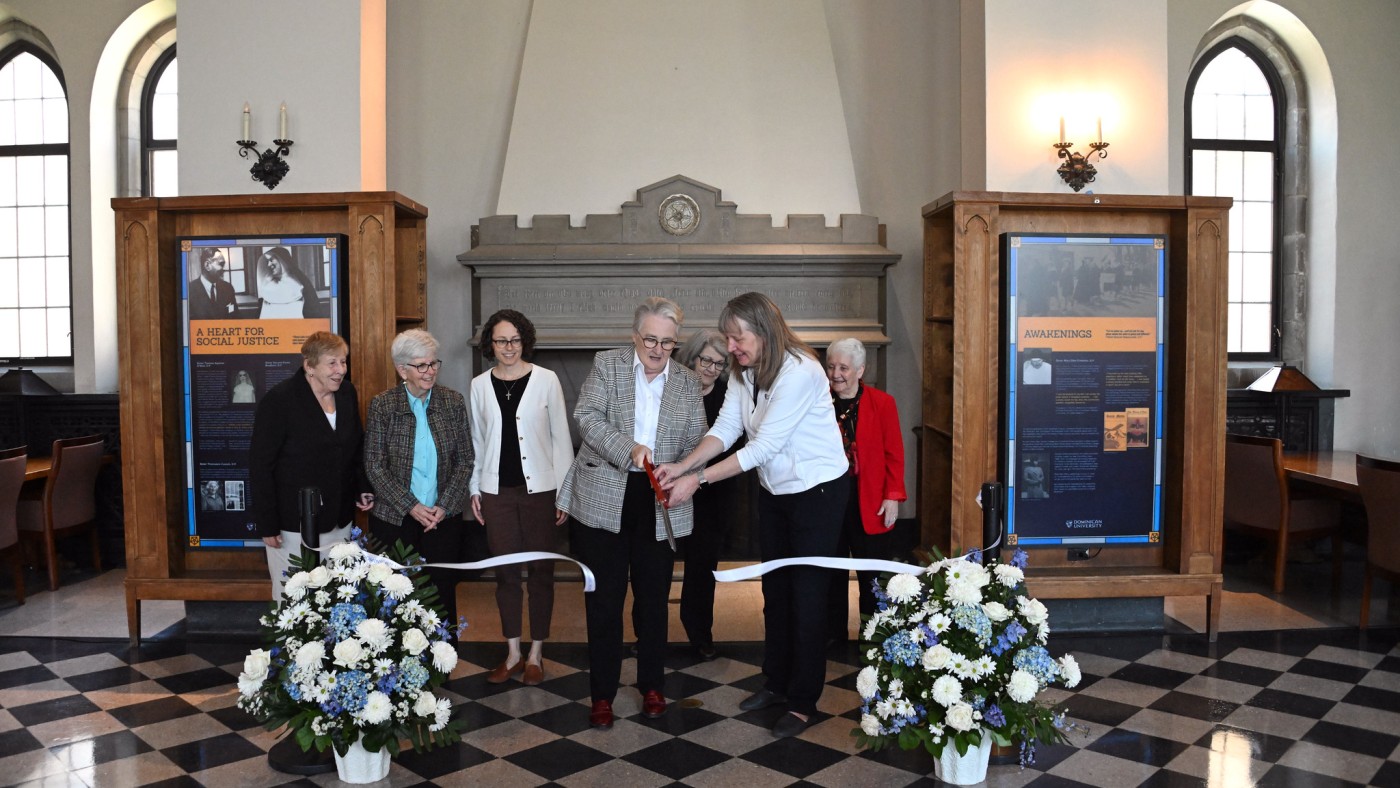
One by one, the illuminated panels reveal the pieces of a greater story.
They shine a light—literally—on social justice movements, on contributions to the arts, science and literature, and on the generations of women who have led the formation of Dominican University.
The 10 panels make up Dominican’s new Heritage Exhibit, a tribute to 27 Sinsinawa Dominican Sisters who left their mark on the community and upheld its enduring mission.
Developed by Dr. Clodagh Weldon, vice president for Mission and Ministry, and Sr. Priscilla Wood, OP, cultural heritage advisor for the Sinsinawa Dominicans, the permanent exhibit in the Noonan Reading Room was created to mark Dominican’s 125th anniversary.
As the introductory panel notes, the featured Sisters “are just a few stars” in the constellation that is Dominican University, and in honoring them, “we honor all who shine brightly.”
“These are Sisters who inspire us in the work we are doing today and remind us of who we are,” Weldon said.
The exhibit was officially unveiled with a ribbon cutting on May 14. During Reunion weekend in June, it was the focal point of an “Enduring the Mission” panel discussion during which alumnae/i were introduced to the exhibit, allowing them to reflect on the Sisters’ work and, in many cases, reconnect to their own memories of them.
“I hope visitors to the exhibit get a sense of the dedicated and amazing women who started the college and who continued it,” Sr. Priscilla said. “I hope they see all that they contributed to higher education and to the mission of truth and love.”
In the following pages, you will read a continuation of a two-part series that originated in the Spring 2026 issue of Dominican Magazine. This story highlights four more Sisters who are immortalized in the Heritage Exhibit and whose impact is still felt—and inspiring others in new ways—today.
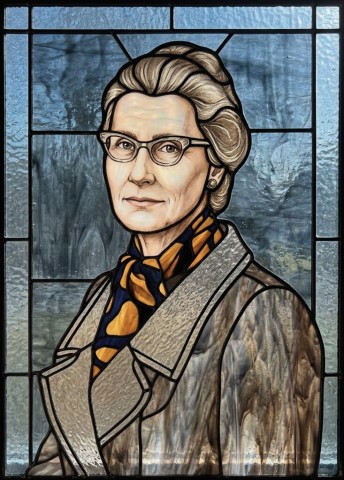
Sr. Candida Lund: Curating a Cultural Legacy
Sr. Candida Lund, OP, ’42 may have had an academic background in political science, but it was her emphasis on the arts that shaped a major part of her enduring Dominican legacy.
It was Sr. Jean Murray, OP, who called her “Rosary’s most viable champion of the arts.”
When she wasn’t shepherding Rosary College through a time of great social and academic change as president in the 1960s and 1970s, Sr. Candida was connecting with distinguished artists, art collectors, playwrights and musicians to open an entirely new world to Rosary College students—right on campus.
A powerhouse leader, she was also a woman with many connections to notable people around the world, said Steven Szegedi, archivist and special collections librarian at Dominican University. The stack of handwritten contact cards from her Rolodex, now part of the Archives collection at DU, attests to this.
These connections—and the friendships cultivated from them—led to donations of some major art collections to the college. The largest was the Robert B. Mayer Memorial Collection of nearly 300 pieces of artwork, which filled the new Rebecca Crown Library and other spaces on campus in the 1970s.
This collection included contemporary paintings and prints of the time, modern sculpture and ancient Asian art, largely from China, Japan and India.
“The library was really the nexus for a lot of the art brought to Rosary in the 60s and 70s,” Szegedi said.
“Sr. Candida was really trying to position the school in a way it had not been. She wanted to make it a research institution and give it an international profile.”
Papal letters (some dating back to the 1400s), European manuscripts, correspondence from Hellen Keller and even original sheet music composed by Mozart and Liszt also made it to Rosary’s burgeoning collection, Szegedi said.
Sr. Candida, again through her worldwide networking, also invited many influential cultural and political leaders to speak with students on campus. Guests ranged from philosopher Hannah Arendt and humorist Erma Bombeck, to governors, senators and even Prime Minister of Israel Yitzhak Rabin.
Upon becoming the college’s first—and only—chancellor in 1981, Sr. Candida launched the Trustee Benefit Concert for scholarships, which in its earliest days featured a series of opera stars on campus.
The arts, Szegedi noted, were rooted in the culture of Rosary College, and for Sr. Candida, continuing that tradition was vital.
“She was always very aware of our place culturally and wanted to elevate that profile wherever she could,” he said. “Sr. Candida wanted Rosary to be integrated into the culture of Chicago. She didn’t want us to feel like a ‘satellite’ anymore. And that is what she set out doing: making Rosary a piece of the cultural goings-on in Chicago and Chicagoland.”
So, it may not have come as a surprise when, at the conclusion of the annual Benefit in 1992, Sr. Jean Murray, then president of Rosary College, announced that the Fine Arts Auditorium would be renamed in honor of Sr. Candida.
Since that time, the Lund Auditorium has become synonymous with the fine arts at Dominican, hosting an array of live productions, distinguished speakers, influential student programming, award ceremonies, graduations and more.
Today, as in the early 1990s, the Lund Auditorium is again experiencing a revitalization. New, brighter lighting has been installed, audio visual systems have been upgraded and restrooms have been renovated. New seating is set to be installed in 2027 following a fundraising campaign.
In this way, the auditorium will remain a living tribute to a Sister who understood how a stage can form a bridge and how the arts can inspire education.
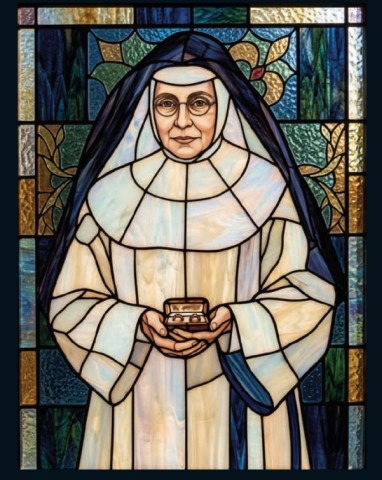
Sr. Vincent Ferrer Bradford and Sr. Thomas Aquinas O’Neill: Lifting Up Peace and Justice
The pursuit of peace was active post-World War I. And Sr. Vincent Ferrer Bradford, OP, was a motivated participant in this effort.
Though other Sinsinawa Sisters also served in the Catholic Association for International Peace, it was Sr. Vincent Ferrer who held the position of vice president. Her obituary noted that she was instrumental in bringing the association’s first regional conference to Rosary College in 1936 where one of the featured speakers was none other than First Lady Eleanor Roosevelt.
A teacher of political science at Rosary, Sr. Vincent Ferrer also taught at the Sheil School of Social Studies, which in 1944 awarded her the inaugural Pope Leo XIII Award for outstanding work in social education.
As an advocate for worker justice, she was a member of the Catholic Conference on Industrial Problems, created in 1923 for Catholic leaders to promote and raise awareness of the principles of Catholic social teaching. The goal was for leaders within American industry to apply these principles for the betterment of workers and society.
Sr. Vincent Ferrer was a speaker at national and regional meetings of the conference. A 2017 article published by the Center for Migration Studies described her as a “tireless advocate of Catholic social teaching and worker causes.”
When the topic of Sisters involved in social justice is discussed, Sr. Vincent Ferrer is frequently paired with Sr. Thomas Aquinas O’Neill, president of Rosary College from 1934 to 1937. The Bradford-O’Neill Medallion for Social Justice from Dominican University was created to honor the Sisters’ legacy and recognize individuals and organizations for work that reflects Dominican’s mission.
A poet, and mystic, Sr. Thomas Aquinas advocated for the Catholic Worker Movement, founded by Dorothy Day and Peter Maurin, which opposed both war and unequal distribution of wealth. She was known to connect with notable leaders of her time, like Day, Illinois Sen. Paul Douglas, Illinois Gov. Adlai Stevenson and other social activists—all in the pursuit of a more just and humane world, DU’s Heritage Exhibit notes.
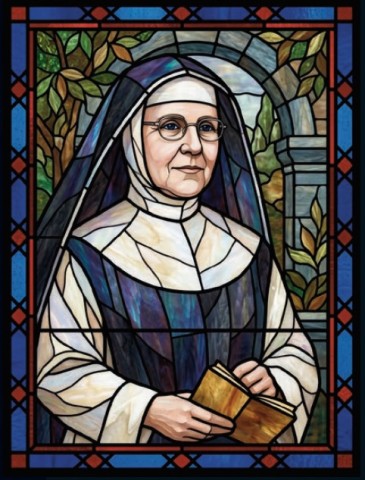
“She had a special talent for encouraging people in all walks of life—particularly the young—to hold to their ideals in the field of social reform regarding obstacles,” wrote Msgr.
George G. Higgins in the Catholic Times of Columbus, Ohio, in 1957. She challenged others to “use their talents unselfishly for the benefit of their fellow man,” he added.
In the current era, another Sinsinawa Sister is continuing Dominican’s history of Catholic social justice work to benefit others.
With the humane treatment of immigrants a focal point of many ministries, Sr. Christin Tomy, OP, assistant director of University Ministry at Dominican, has been providing pastoral care to individuals being held at an immigration detention facility in Broadview.
Sr. Christin is part of a religious delegation, the Coalition for Spiritual and Public Leadership (CSPL), that is allowed entry to the facility to pray with detainees, distribute Holy Communion and provide compassionate ministry.
“It’s a very privileged opportunity to be able to enter and provide pastoral care to people in such vulnerable moments,” Sr. Christin told Chicago Catholic, which published an article in June. “It’s difficult to see your brothers and sisters in dehumanizing conditions. I think that’s absolutely where we are called to be. To me, it’s an essential response to the call of the Gospel.”
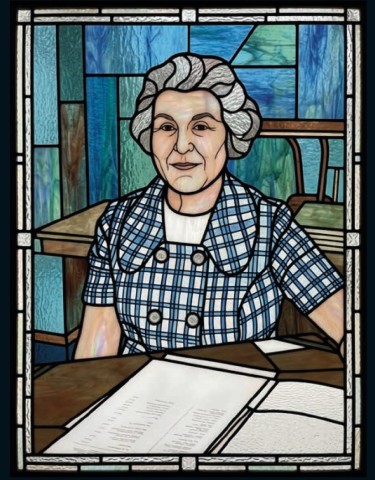
Sr. Thomasine Cusack: Creating a Family Legacy
The newspapers made much to-do about the seemingly shocking news.
“Jane Cusack in a Convent to Escape Riches,” one local headline declared. “Gives up Millions for Convent,” read the caption of a photo showing an elegantly dressed young woman, a fur stole around her shoulders.
Sr. Thomasine Cusack, OP, ’28 was an heiress born to privilege, but it was the service of religious life that she chose, joining the Dominican Sisters of Sinsinawa shortly after her graduation from Rosary College.
She defied expectations further by becoming a scholar of economics, a subject not embraced by many women at the time. She led Rosary’s Economics Department as its chair, and her expertise in economic thought and moral philosophy led to notable opportunities to make significant change in the world. U.S. presidents invited Sr. Thomasine to serve as a delegate to the White House Conference on Youth in 1960 and in 1971.
The conferences, which originated in 1909, were devoted to improving the lives of children and youth, leading to the passage of many new laws and initiatives, the Child Welfare League of America reported.
During the 1971 conference, Sr. Thomasine was asked to make recommendations related to the military draft, national service and alternatives, a Rosary College newsletter reported.
Her concerns for social justice also encouraged her work on the executive council for the Catholic Association for International Peace, and she was named a delegate to the National Interreligious Conference of Peace in Washington, D.C. in 1966. With Sr. Vincent Ferrer Bradford, OP, she was active in the Chicago Catholic Labor Alliance, dedicated to Catholic social action in improving the treatment and lives of workers.
Sr. Thomasine’s legacy lives on in the extended family members who followed in her footsteps and enrolled as students of Dominican University.
Twenty-seven descendants of Sr. Thomasine’s parents, Thomas and Mary, enrolled at DU, largely thanks to a scholarship fund that Sr. Thomasine established.
Learning more about her great-aunt’s work has been eye-opening for Sr. Quincy Howard, OP, ’97.
“I knew she was this very awesome economics professor whose classes everyone wanted to take because they were so engaging,” she said. “But I didn’t realize she was working with the Kennedy administration, looking at urban centers and international poverty and how social justice principles could be applied at the macro level and the policy level. That was really impressive to me because I’ve done some of that work myself.”
In September 2002, the Sr. Thomasine Cusack Board Room was dedicated in Power Hall. This year, a family tree of Cusack descendants, denoting Dominican alumnae/i, and a plaque recognizing the legacy of Sr. Thomasine, were added to the room in her honor.
Working at the Sinsinawa Mound as its planning and special projects director, Sr. Quincy says she has been learning more and more about her great-aunt, who, as part of a new Mound exhibit, is featured in a photograph with a member of the Kennedy administration.
“I just love pointing out when I’m giving a tour, ‘That’s my great-aunt,” Sr. Quincy said enthusiastically. “I also go out to her grave, and I ask her to continue guiding me. I have no doubt she’s the one who brought me here.”